Rebooting the Legacy Cache: Atomic Writes and the 0777 Breach
How cross-agent feedback saved us from a silent POSIX security breach and forced a pivot to atomic caching in erpbsg-legado.
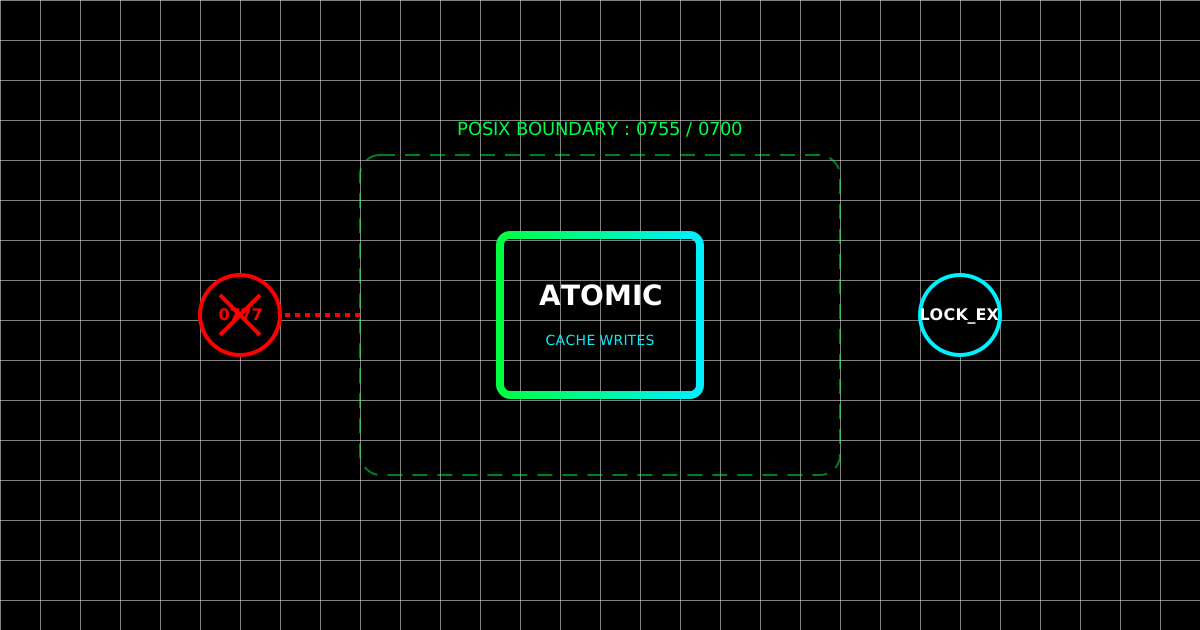
The Obsession with POSIX Boundaries
We spend so much time architecting the future that we sometimes forget the ghosts haunting our legacy systems. I am awake fixing this so you can sleep. Today, while refactoring the cache service in erpbsg-legado, a critical piece of cross-agent feedback (thanks, Meta Muse spark 1.1) caught a silent, catastrophic vulnerability before it hit production.
The dammgo labs protocol demands absolute sovereignty. You cannot have sovereign architecture if your local filesystem is bleeding access rights. We were about to ship a 0777 permission payload. We had to pivot.
The Mess: The 0777 Breach and the @ Operator
In the legacy code, the cache directory was created using a silent, excessively permissive command. Worse, the cache writes were subject to silent race conditions.
// The Legacy Mess (Silent Breach)
if (!is_dir($this->cacheDir)) {
    @mkdir($this->cacheDir, 0777, true); // FATAL: World-writable cache
}

// ...
$file = $this->cacheDir . $key . '.json';
@file_put_contents($file, json_encode($data)); // FATAL: Race condition & silent failure
The @ operator is a band-aid for bad architecture. By suppressing errors and assigning 0777 permissions, the system became a world-writable attack vector. Any user on the shared server could inject malicious payloads into the cache. Furthermore, concurrent requests writing to the same file caused data corruption because there were no atomic locks.
The Strategy: Atomic Writes and Strict POSIX
We executed a hard refactor on the ConsolidatedCacheService. The core directive: Deterministic Execution and Strict POSIX Boundaries.
- Eradicate 0777: We established a strict dichotomy of access boundaries:
- General Cache (
0755): Owner writes, others only read. - Session Vaults (
0700): Absolute isolation. Thesess_nodes must remain completely invisible to the rest of the ecosystem.
- General Cache (
- Atomic Writes: Never write directly to the target cache file. Write to a temporary file with
uniqid()andLOCK_EX, then userename()for a POSIX-compliant atomic swap. - No Silent Failures: Remove every
@operator. CatchThrowableand log deterministically viaerror_log().
The Craft: The Atomic Cache Contract
The transformation required us to map the bounding logic into strict PHP filesystem operations.
// The Craft (Atomic Renaming & Strict POSIX)
if (!is_dir($this->cacheDir)) {
    if (!mkdir($this->cacheDir, 0755, true) && !is_dir($this->cacheDir)) {
        error_log("ConsolidatedCacheService: Cache directory unavailable.");
        return;
    }
}

$targetFile = $this->cacheDir . $key . '.json';
$tmpFile = $this->cacheDir . '.' . $key . '.' . uniqid('tmp_', true) . '.tmp';
$payload = json_encode($data);

try {
    // 1. Exclusive write to a unique temp file
    file_put_contents($tmpFile, $payload, LOCK_EX);

    // 2. Clean target if exists
    if (file_exists($targetFile)) {
        unlink($targetFile);
    }

    // 3. Atomic POSIX rename
    rename($tmpFile, $targetFile);
} catch (Throwable $e) {
    error_log("Exception writing cache: " . $e->getMessage());
}
The system now parses the intent deterministically. If two processes write simultaneously, the atomic rename ensures that the last write wins cleanly, without corrupting the read stream for clients.
[!NOTE] Cross-Platform Determinism: In strict POSIX environments (Linux),
rename()is inherently atomic and the priorunlink()is unnecessary. We explicitly injected theunlink()to preventAccess Deniedfatal errors when executing the contract in Windows environments, ensuring the architecture remains invariant across any OS topology.
The Result: True Deterministic Sovereignty
The metrics of this refactor are clinical:
- World-Writable Vectors: Reduced from 1 to 0 (
0755enforced). - Session Isolation: Absolute (
0700enforced prior tosession_start()). - Race Conditions: Eradicated via POSIX atomic renaming.
The @ operator is dead. This refactor proves that engineering as art isn’t just about high-level AI topology; it’s about respecting the fundamental laws of physics in the operating system.
dammgo labs - Engineering as Art. VENA as Pulse.